Rochdale and Littleborough Flood Risk Management Scheme
The Rochdale and Littleborough Flood Risk Management Scheme (FRMS) has been developed to reduce flood risk from the River Roch and its tributaries for communities across Rochdale and Littleborough, Greater Manchester. The towns have a long history of flooding, with over 300 properties affected by severe flooding during Storm Eva in 2015. Led by the Environment Agency in partnership with Rochdale Borough Council, Network Rail, Transport for Greater Manchester and the Department for Education, the scheme forms part of one of the largest inland flood relief programmes in the north of England.
The project is being delivered in multiple phases. Phase 1A in Littleborough included the demolition and replacement of the Riverstone Road bridge and footbridge with a new combined 22m single-span bridge, river widening works and improvements to existing flood walls. Phase 1B in Littleborough is focused on constructing a Category A flood storage reservoir at Gale, along with linear flood defences, sheet piling, river diversions and improvements to existing flood infrastructure along the River Roch, Greenvale Brook and Ealees Brook. Phase 2 in Rochdale is currently in the design phase and will look to combine a series of linear defences along the River Roch and Buckley Brook, alongside the creation of two flood storage reservoirs.
Once complete, the overall scheme will better protect 723 homes and 488 businesses from flooding, whilst also improving resilience for local transport infrastructure and public assets.
Purpose
The Rochdale and Littleborough FRMS has been designed to provide long-term flood resilience for the local community.
The project has been designed to reduce flood risk from the River Roch and surrounding watercourses while improving protection for homes, businesses and local infrastructure. The scheme also aims to create additional flood storage capacity, improve river flow and conveyance, enhance biodiversity and deliver the works using innovative low carbon construction techniques.
Phase 1B has also become a host project for the Environment Agency’s Decarbonisation Technology Accelerator (DTA) programme, supporting the trial and implementation of low carbon materials and construction methods.
What we are doing
VolkerStevin is delivering the scheme using a collaborative engineering approach, working closely with the Environment Agency, Network Rail, Rochdale Borough Council and the wider project team.
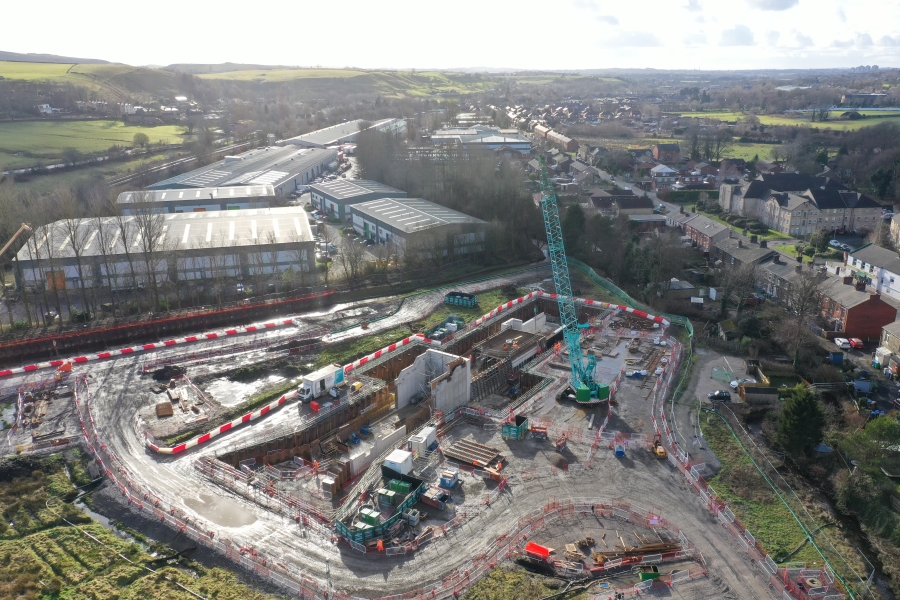
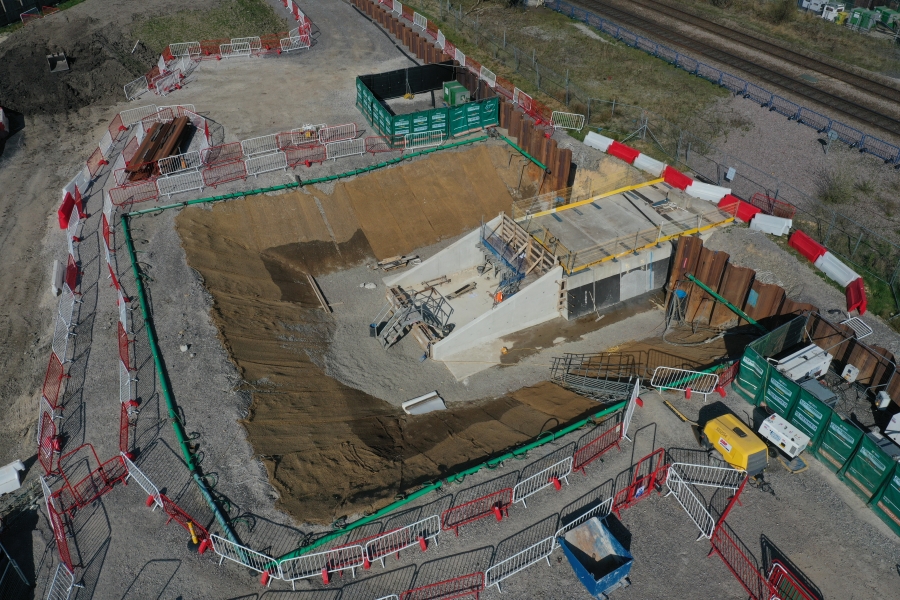
Early enabling works included designing and installing sheet piled ramps and laydown areas to facilitate the installation of a conveyance culvert beneath the operational Calder Valley railway line. A river diversion was also completed to enable the culvert installation works.
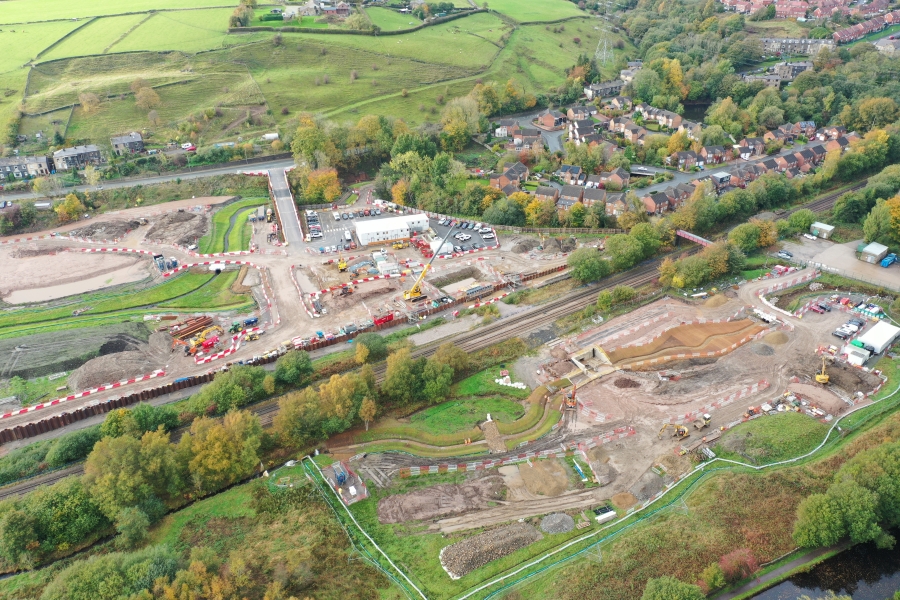
Phase 1B includes the construction of a Category A flood storage reservoir at Gale with a storage capacity of approximately 80,000m³. The works include earth embankments, reinforced concrete flow control structures, spillways, sheet piled walls, culvert crossings and new river diversion channels.
The reservoir is split into Gale West and Gale East, requiring substantial earthworks, piling operations and modifications to the River Roch and Greenvale Brook. The project also includes habitat improvements, erosion control measures and biodiversity enhancements.
At Gale West, the team completed a 300m river diversion channel, including wildflower planting and fish habitat creation.
VolkerGround Engineering carried out extensive piling works across the project, including temporary cofferdams, spillway piles, wingwall piles, box piles and cut-off walls using specialist equipment including leader rigs, pile presses, Movax systems and long reach excavators.
At Grove Lodge, due to the close proximity of the Calder Valley Railway Line, the installation of sheet piles is being carried out using a Giken Supercrush. This advanced silent piling machine is allowing the team to install sheet piles into hard ground, without causing noise or vibration.
The project team established a materials testing laboratory on site to support quality assurance, monitor earthworks performance and carry out concrete testing.
The complexity of the scheme also led to several design changes during delivery. The reservoir layout was revised to maximise storage on the Gale West side of the site, while a planned clay embankment adjacent to the railway was changed to a sheet pile wall to reduce the footprint and increase storage capacity.
Sustainability and innovation are central to the delivery of Phase 1B.
As part of the DTA programme, the project trialled three key low carbon initiatives:
- Low carbon steel
- Low carbon concrete
- Modern methods of construction and digital technologies
Over 2,000 tonnes of EcoSheetPile™ Plus sheet piles have been installed across the scheme. Manufactured using 100% recycled steel and renewable electricity, the piles reduced carbon emissions by approximately 2,400 tonnes of CO2 compared to traditional hot-rolled sheet piles.
The project also utilised lower carbon ternary concrete mixes using limestone fines and Ground Granulated Blast Furnace Slag (GGBS) to replace part of the traditional cement clinker. Approximately 1,800m³ of structural concrete has been used on the scheme, including a major flow control structure measuring approximately 80m long and 8m high.
The revised concrete mixes achieved carbon savings of:
- 7.8tCO2e on the C40/50 concrete mix
- 4.5tCO2e across other concrete mixes
The project additionally trialled 3D machine control technology during excavation of the river diversion channels. The technology improved excavation accuracy, reduced over-excavation and improved programme efficiency.
The use of 3D machine control achieved:
- Reduced fuel consumption by 628 litres
- Reduced carbon emissions by approximately 1,680kgCO2e
- Approximately 25% programme efficiency improvement
- Reduced engineer intervention and setting out requirements
Further sustainability initiatives include:
- Use of hybrid excavators with approximately 25% lower fuel consumption
- Purchase of 800,000 litres of HVO fuel to reduce diesel usage
- Reuse of demolished bridge concrete within haul roads
- Wetland creation and habitat improvements
- Wildflower planting and fish habitat creation
The project team has also maintained strong engagement with the local community throughout delivery. Residents and businesses are kept informed through meetings, newsletters, updates and face-to-face engagement.
Social value initiatives delivered through the project include:
- Hosting students during Build UK Open Doors events
- Supporting the Constructing Change initiative to encourage greater diversity within construction
- Supporting local charities, schools and foodbanks
- Donating timber and wood chippings for community use
- Welcoming educational groups, delegates and government representatives to site
The project also received visits from Floods Minister Emma Hardy MP, the local MP Paul Waugh, Borough Councillors, Flood Action Groups and other community stakeholders, recognising the importance of the scheme to regional flood resilience.
Project successes
The Littleborough FRMS has delivered significant progress towards improving long-term flood resilience across Greater Manchester, with the Rochdale FRMS being designed to follow on from these works.
The project has also demonstrated how major flood defence schemes can successfully integrate sustainability and low carbon innovation into delivery.
Key achievements include:
- Construction of a major flood storage reservoir and associated flood defences
- Delivery of significant embodied carbon reductions through low carbon steel and concrete solutions
- Successful use of digital construction technologies to improve efficiency and reduce emissions
- Habitat creation and biodiversity enhancements across the site
- Strong collaboration with the Environment Agency, Network Rail and project stakeholders
- Delivery of extensive social value and community engagement initiatives
The Littleborough FRMS continues to provide valuable learning around low carbon flood defence delivery, helping to inform future infrastructure projects across the UK.