


Rother Tidal Walls East Flood Defence Scheme
VolkerGround Engineering has delivered sheet piling works as part of the Rother Tidal Walls East project in Rye. The project will help to prevent major flooding in East Rye and Guldeford, as well as tidal flooding across Romney and Walland Marshes.
Part of the scope included sheet piling works at Kings Avenue, this area presented a challenge due to the limited room for construction of a suitable piling platform. The existing flood embankment was only 2m wide at the crest, with steep slopes down to the river on one side and residential properties on the other. The team considered all piling methods, but they all involved substantial piling platforms to provide suitable access for normal construction plant.
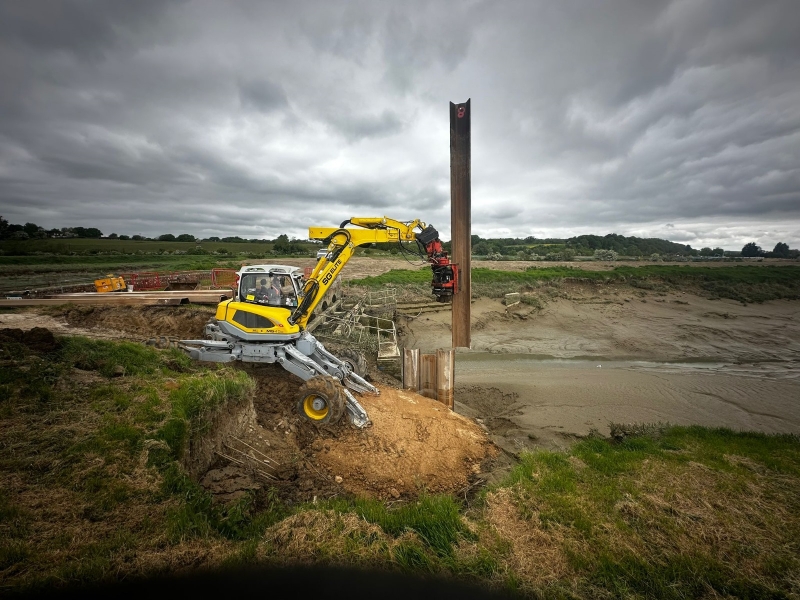
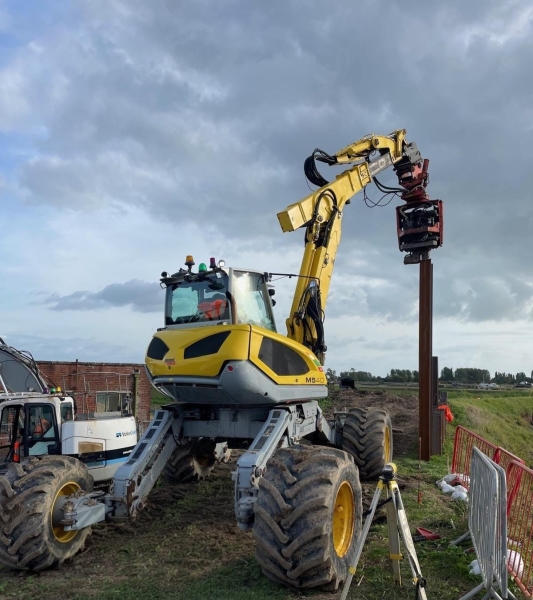
As a result, and with some innovative thinking, the team developed the concept of using a spider excavator with an excavator mounted vibratory attachment. The spider excavator could access areas that conventional piling rigs and machinery were unable to reach, removing the need for a traditional piling platform in these locations.
At Kings Avenue, 240 linear metres of piling was completed using the spider excavator, with 4.7m-long AZ20-700 sheet piles installed. This approach minimised noise and vibration disruption to nearby residents. With no platform in place, our distribution became the next problem to overcome. Sheet piles were delivered on rigid wagons, rather than articulated trailers, the team used a telehandler to offload the piles which were then delivered to the works area on a remote-controlled carrier.
By using a spider excavator at Kings Avenue and eliminating the need for a temporary platform, the project delivered a 43% programme saving, a 65% cost reduction and an 82% decrease in carbon emissions for our client.
The project’s approach to challenging access, piling platform requirements and specialist installation at Kings Avenue was recognised at the 2025 Ground Engineering Awards, where it won the Geotechnical Value award for projects valued up to £500,000.

The next phase of works took place at Camber Fields, where the team installed 6.5m-long AZ18-700 sheet piles and a 7m-long, 600mm-wide capping beam. Working from a clay platform, a 23t excavator was used to complete the installation. Appropriate plant was selected to drive the piles to the required design toe level without the need for impact driving, reducing noise and minimising disturbance to wildlife within the sensitive estuary environment.
Following the success of the works at Kings Avenue, the team trialed using different sheet pile lengths and sections, to assess noise, vibration and driveability. The trial considered installation both with pre-augering and in virgin ground. The results of the trial allowed the development of sheet piled solutions at Monk Bretton Crest and Union Sluice.
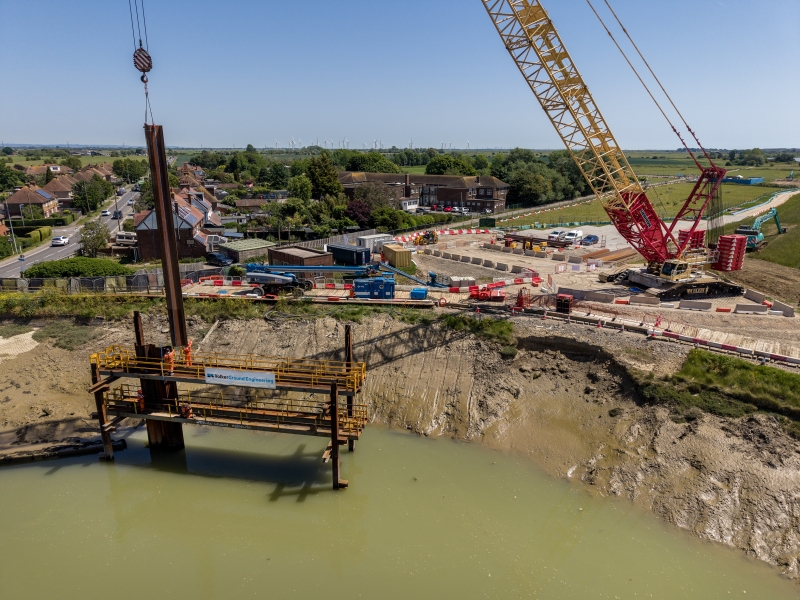
8m-long GU sheet piles were installed at Union Sluice. The spider excavator installed the piles along the bank of the River Rother, gradually extending the ground to provide access for the installation of the remaining piles.
The Monk Bretton crest piling works comprised 6.5m-long GU21N sheet piles and 6 linear metres of capping beam. These works were completed using the spider excavator with a Movax attachment.
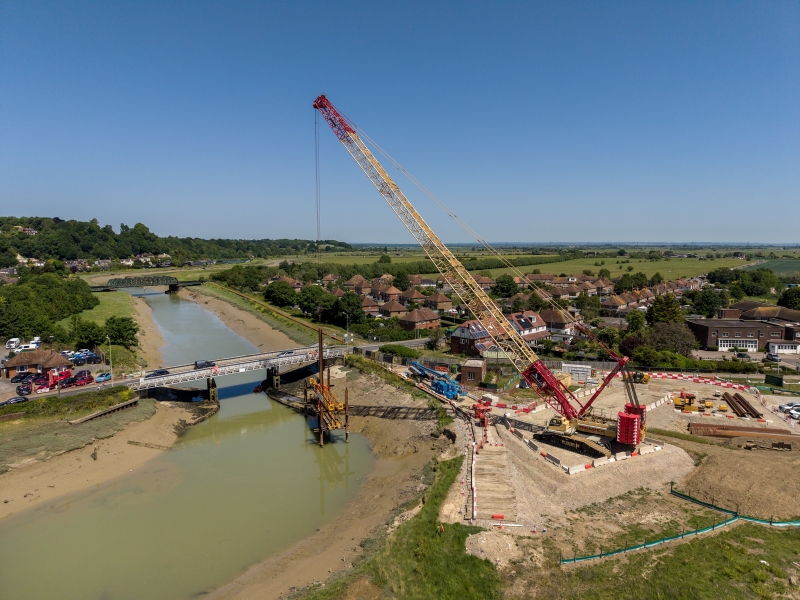
At Monk Bretton toe, 12m-long AZ26-700 sheet piles were installed across 50.4 linear metres of the river embankment. The works were carried out using a conventional piling methodology, with an LR1500 lattice crawler crane operating across four piling gate set-ups. A 250t mobile crane supported rigging and de-rigging activities. The piles were initially driven using a 60HV crane-suspended vibratory hammer, with a CX60 impact hammer deployed where required to overcome refusal and achieve the specified toe level.
Alternative installation methods were reviewed for the Monk Bretton toe works. However, the distance between the pile line and the available location for the piling platform was too great for other piling machinery, including long-reach equipment. The selected methodology allowed the works to be delivered while minimising disruption to members of the public and users of Monk Bretton Bridge.


